Build Your Own RTD (Resistance Temperature Device)

Can’t find the exact option you need? No problem — if your required specification isn’t listed during this build, simply get in touch with us by phone, email, or through our website and our team will be happy to provide a custom quote tailored to your requirements.
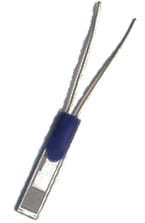
RTD – Resistance Temperature Device

Due to the need in Industry for greater accuracy and stability of the Resistance Temperature Device(RTD) are more widely used.

The Platinum RTD, having a normal resistance of 100 ohms at 0°C and a temperature coefficient of 0.0385 is regarded as a world standard.  RTD’s are constructed in two categories.

  • Wire-wound RTD’s are created by winding a thin wire into a coil.
  • A more common configuration is the thin-film element, which consists of a very thin layer of metal placed on a plastic or ceramic substrate.

Thin-film elements are cheaper and more widely available because they can achieve higher nominal resistances with less platinum.

Their disadvantages, compared to the Thermocouples, are:

  • smaller overall temperature range.
  • higher initial cost.
  • less rugged in high vibration environments.

Detector tolerance and Accuracy

The RTD Bulbs used in D&N’s assemblies conform to BS 1904:1964 and DIN 4376 and in standard form have a tolerance of 0.1% of resistance. (Other tolerances of 0.05%, 0.03%, 0.02% and 0.01% are available on request). Also available are nickel 100 ohms and Platinum 130 ohms, 500 ohms and 100 ohms. The most common type pt100 has a resistance of 100 ohms at 0°C and 138.4 ohms at 100°C. There are also pt1000 sensors that have a resistance 1000 ohms respectively at 0 C.

Platinium RTD tolerance values

Temperature °CResistance Value ΩClass A°C (Ω)Class B°C (Ω) 
-20018.49±0.55-(±0.24)±1.3-(±0.56)
-10060.25±0.35-(±0.14)±0.8-(±0.32)
0100.00±0.15-(±0.06)±0.3-(0.12)
100138.50±0.35-(±0.13)±0.8-(±0.30)
200175.84±0.55-(±0.20)±1.3-(±0.48)
300212.02±0.75-(±0.27)±1.8-(±0.64)
4002477.04±0.95-(±0.33)±2.3-(±0.79)
500280.90±1.15-(±0.38)±2.8-(±0.93)
600313.59±1.35-(±0.43)±3.3-(±1.06)
650329.51±1.45-(±0.46)±3.6-(±1.13)

RTD Types

  • Gold  – Au   @   13.00(ohms/cmf)
  • Silver  – Ag  @   8.8(ohms/cmf)
  • Copper –  Cu @   9.26(ohms/cmf)
  • Platinum –  Pt   @  59.00(ohms/cmf)
  • Tungsten –  W   @  30.00(ohms/cmf)
  • Nickel – Ni  @   36.00(ohms/cmf)

Within the above types gold and silver are rarely used within the industry, copper is used in an economical situation but the bulb tends to be longer than that of a platinum bulb and the max temperature is only 130°C. Tungsten has a high resistance and is used in very high-temperature situations, it is brittle and difficult to work with. In most cases, the RTD is made from Platinum or nickel which tends to have a drifting problem and is non-linear in its scale over time.

The most common RTD used is the Platinum pt100 ohm which offers excellent accuracy over a wide temperature range from -200 to 850 C.

The advantages of RTD’s include:

  • Stable output for long period of time.
  • Ease of recalibration.
  • Accurate readings over relatively narrow temperature spans.

Connecting RTD’s

There are three main methods to connecting RTD’s to the measuring instruments. Each method should be matched to the measuring instrument or control device.

Two Wire RTD Connection
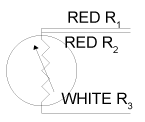
Three Wire RTD Connection
Four Wire RTD Connection

RTDs vs Thermocouple

The two common ways of measuring industrial temperatures are with resistance temperature detectors (RTDs) and thermocouples. The choice between them is usually determined by these four factors.

  • Temperature: If process temperatures are between −200 to 500 °C, an industrial RTD is the preferred option. Thermocouples have a range of −180 to 2,320 °C. So for temperatures above 500 °C Thermocouples are your only choice of contact temperature measurement devices.
  • Response time: If the process requires a very fast response to temperature changes—fractions of a second as opposed to seconds —then a Thermocouple is the best choice.
  • Size: A standard RTD sheath is 3.175 to 6.35 mm in diameter; sheath diameters for thermocouples can be less than 1.6 mm.
  • Accuracy and stability requirements: If a tolerance of 2 °C is acceptable and the highest level of repeatability is not required, a Thermocouple will serve. RTDs are capable of higher accuracy and can maintain stability for many years, while thermocouples can drift within shorter periods.

The D&N team can lend their 35 years’ experience to assist you in choosing the right RTD sensor for your needs. We also carry a range of stocked RTD sensors for immediate shipping.